

Building a Modern Data Foundation for Banking Analytics and AI Transformation
As banks accelerate digital transformation, they are managing increasingly complex data ecosystems across multiple business systems, including Core Banking, Digital Banking, CRM, Card Systems, Loan Origination Systems (LOS), Treasury, Contact Center, and Risk Management platforms.
However, data is often fragmented across different systems and departments, creating significant challenges in building a unified customer view, generating management reports, ensuring data consistency, and implementing advanced analytics and AI applications.
INDA provides Data Platform for Banks, a modern data foundation designed specifically for financial institutions. The solution enables banks to integrate, standardize, and manage data from multiple banking systems through a unified architecture, supporting Operational Data Store (ODS), Data Warehouse (DWH), Data Lakehouse, and Data Integration capabilities.
With a scalable and open data architecture, banks can improve data accessibility, reduce dependency on disconnected systems, and establish a strong foundation for Business Intelligence, Risk Analytics, Customer Analytics, Regulatory Reporting, Machine Learning, and Generative AI applications.
Banking Data Challenges in Digital Transformation
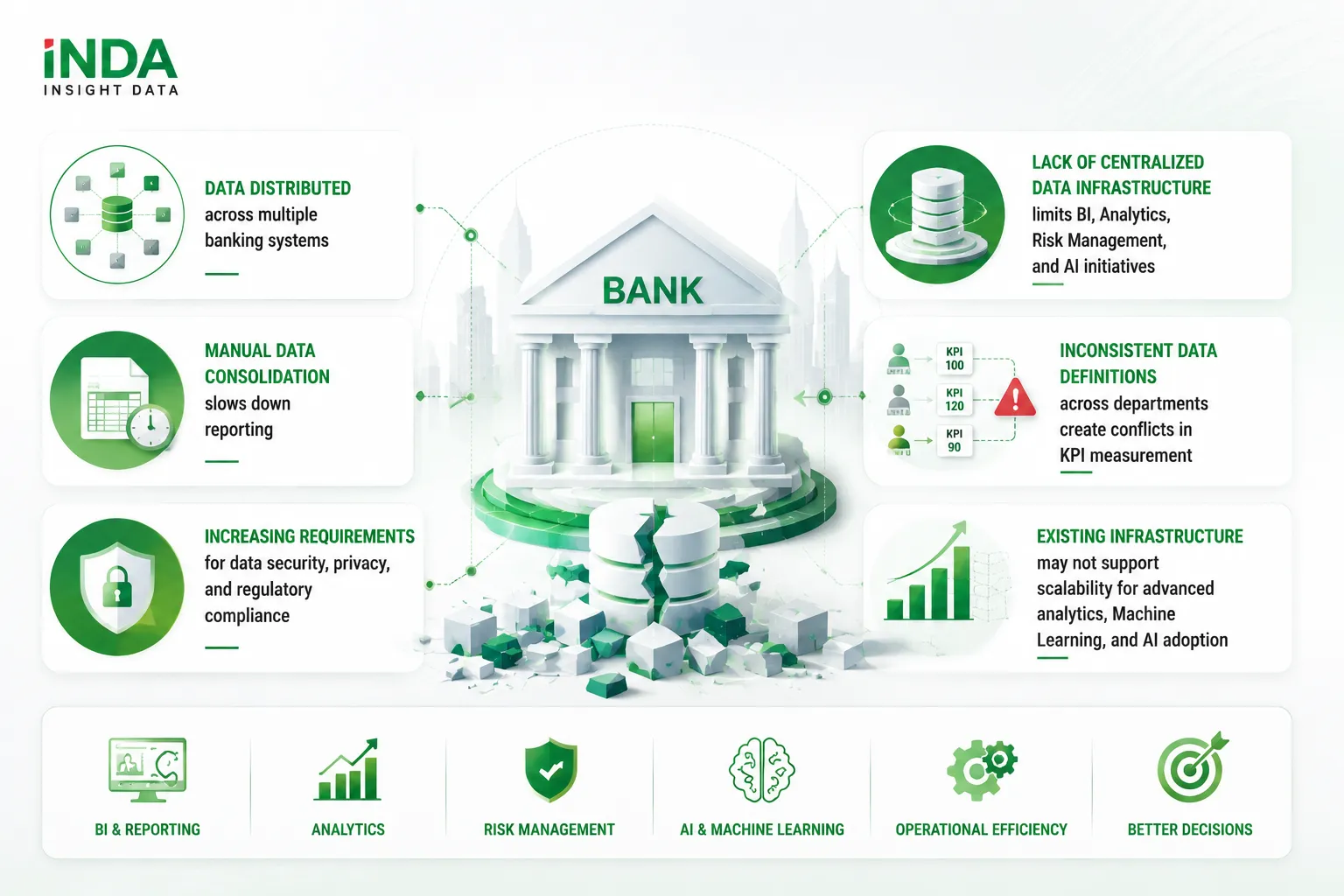
Banks today face several challenges in managing and maximizing the value of enterprise data:
- Data is distributed across multiple banking systems, making customer insights and reporting processes time-consuming.
- Lack of centralized data infrastructure limits the ability to support BI, Analytics, Risk Management, and AI initiatives.
- Manual data consolidation slows down management reporting and decision-making processes.
- Inconsistent data definitions across departments create conflicts in KPI measurement and business analysis.
- Increasing requirements for data security, privacy, and regulatory compliance create additional governance challenges.
- Existing data infrastructure may not support the scalability required for advanced analytics, Machine Learning, and AI adoption.
Data Platform Solutions for Banks
Data Integration
Banking data is generated across multiple systems, but disconnected data flows prevent organizations from gaining a complete and timely view of business operations.
INDA Data Integration solutions connect data from Core Banking, Digital Banking, Card Systems, CRM, LOS, GL, Treasury, Contact Center, and other banking platforms to create a unified data ecosystem.
Business Benefits:
✔ Eliminate data silos across banking systems.
✔ Ensure consistent and synchronized data across platforms.
✔ Support multiple integration approaches including Batch Processing, CDC, and Near Real-Time Data Integration.
✔ Accelerate data availability for reporting, analytics, and digital applications.
Data Warehouse (DWH)
Banks require trusted and centralized data sources to support management reporting, business analysis, risk management, and regulatory requirements.
INDA Data Warehouse solutions create a structured and standardized data repository that enables accurate reporting and enterprise-wide analytics.
Business Benefits:
✔ Build a Single Source of Truth across the organization.
✔ Reduce time spent preparing management and regulatory reports.
✔ Improve data accuracy for analytics and decision-making.
✔ Support banking use cases including credit analysis, risk management, business performance, and compliance reporting.
Data Lakehouse
Modern banking requires flexible data architectures capable of handling structured and unstructured data for advanced analytics and AI applications.
INDA Data Lakehouse solutions combine the capabilities of Data Warehouse and Data Lake architectures, enabling banks to manage large-scale data while supporting BI, Analytics, Machine Learning, and Generative AI.
Business Benefits:
✔ Unify diverse data sources on a flexible Lakehouse platform.
✔ Enable advanced analytics and AI applications.
✔ Optimize large-scale data processing performance and cost efficiency.
✔ Build a future-ready foundation for Data & AI transformation.
Operational Data Store (ODS)
Banks need timely access to operational data for daily business activities, internal applications, and fast reporting. However, directly querying transactional systems can impact operational performance.
INDA Operational Data Store (ODS) provides an intermediate data layer that consolidates operational data from multiple source systems and supports near real-time data access.
Business Benefits:
✔ Consolidate operational data from multiple banking systems.
✔ Provide consistent data sources for operational applications and reporting.
✔ Reduce workload on Core Banking and transactional systems.
✔ Enable faster monitoring of banking operations with continuously updated data.
Data Delivery & Semantic Layer
Different departments often interpret metrics differently, leading to inconsistent reports, conflicting decisions, and reduced organizational agility.
INDA Semantic Layer standardizes business definitions, metrics, and data models across the enterprise—ensuring banking teams operate on a single source of truth for reliable decision-making.
Business Benefits:
✔ Standardize data definitions and business metrics across departments.
✔ Ensure consistent KPI measurement for management reporting.
✔ Enable business users to access insights without heavy IT dependency.
✔ Improve data delivery for BI, Analytics, APIs, and AI applications.
Data Security & Access Control
Banks handle highly sensitive customer and financial data that requires strict security controls, access governance, and audit capabilities.
INDA implements data security frameworks to help financial institutions protect sensitive information and meet banking security and compliance requirements.
Business Benefits:
✔ Control data access based on user roles and responsibilities.
✔ Protect sensitive customer information through Data Masking.
✔ Track data access and changes through Audit Logs.
✔ Support security, governance, and regulatory compliance requirements.
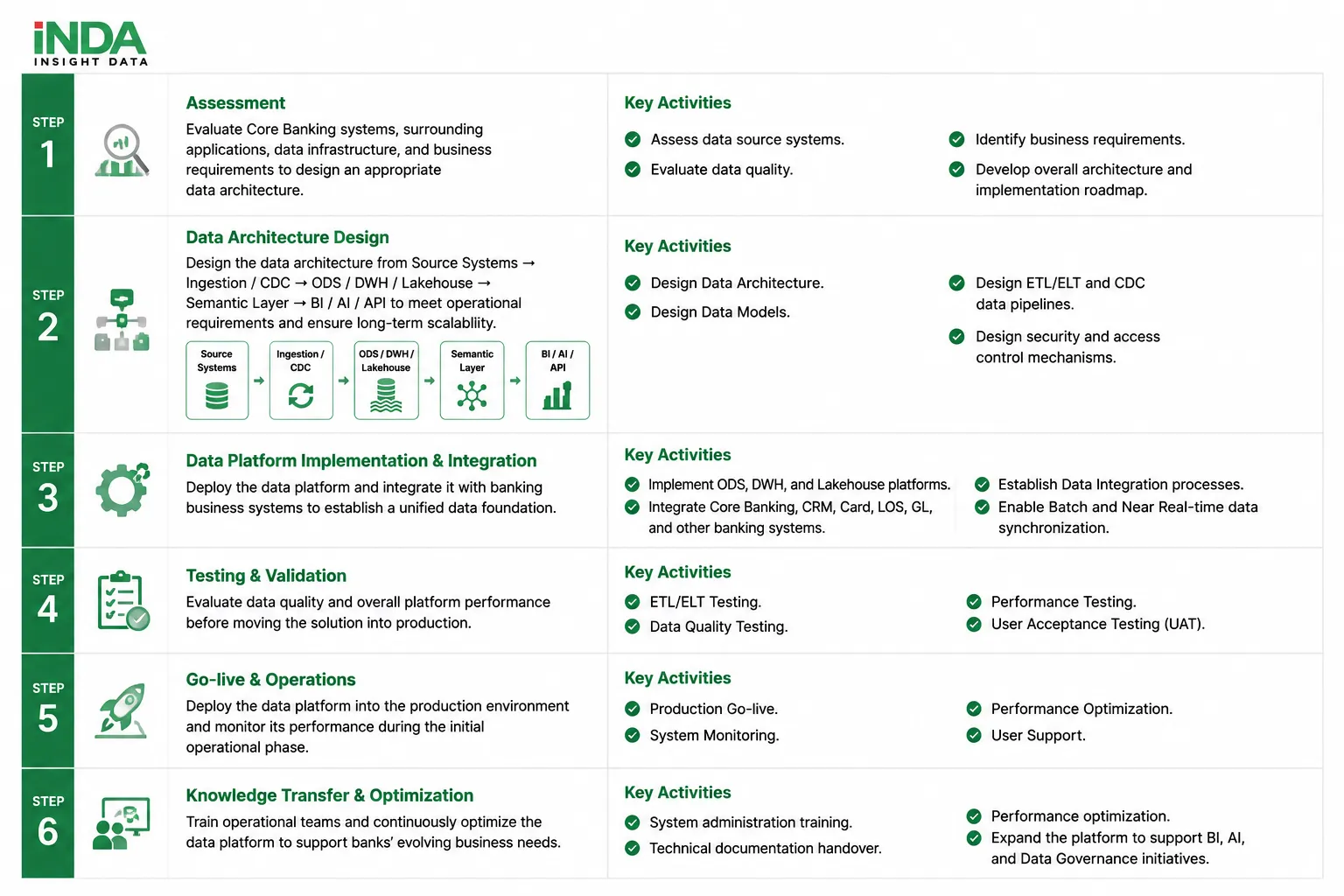
Data Platform Implementation Process for Banks
INDA applies a structured implementation approach to help banks build a modern data platform that enables centralized data management, advanced analytics, regulatory reporting, and AI-driven applications. The process combines banking domain expertise with data engineering capabilities to ensure scalability, security, and long-term operational efficiency.
Why Choose INDA for Banking Data Platform Transformation?
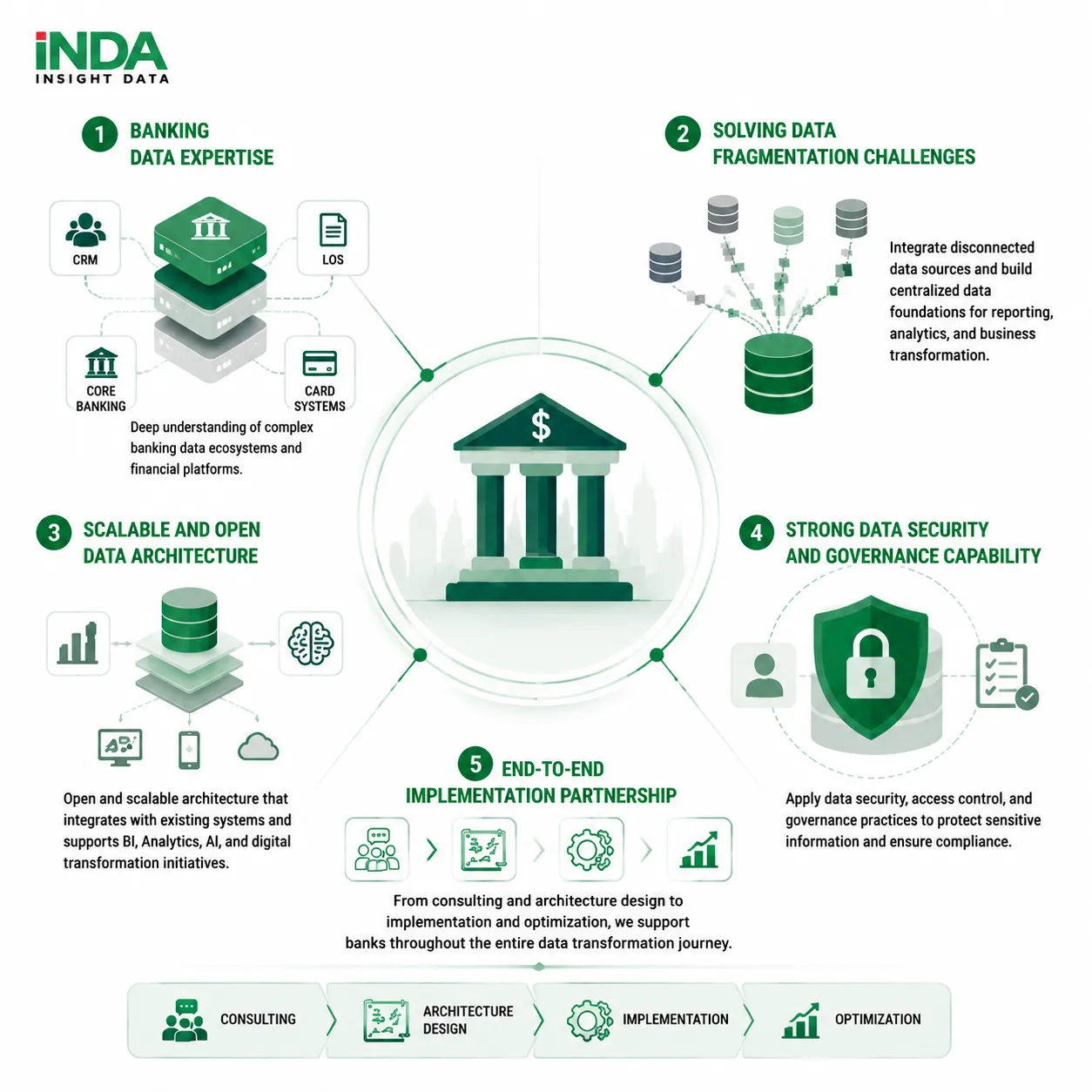
1. Banking Data Expertise
INDA understands the complexity of banking data ecosystems, including Core Banking, CRM, LOS, Card Systems, and other financial platforms.
2. Solving Data Fragmentation Challenges
We help banks integrate disconnected data sources and build centralized data foundations for reporting, analytics, and business transformation.
3. Scalable and Open Data Architecture
Our solutions are designed to integrate with existing banking infrastructure while supporting future BI, Analytics, AI, and digital transformation initiatives.
4. Strong Data Security and Governance Capability
INDA applies data security, access control, and governance practices to help banks protect sensitive information and meet compliance requirements.
5. End-to-End Implementation Partnership
From consulting and architecture design to implementation and optimization, INDA supports banks throughout the entire data transformation journey.
Frequently Asked Questions (FAQ)
1. Why do banks have large amounts of data but still struggle to generate actionable insights?
Banks generate massive amounts of data from Core Banking, Digital Banking, CRM, Card Systems, Loan Origination Systems, and other business applications. However, when data is fragmented across different platforms and departments, banks often struggle to build a complete view of customers, operations, and business performance.
Without a unified data foundation, decision-makers may spend significant time collecting and validating information instead of focusing on strategic initiatives. INDA helps banks establish a modern data platform that integrates and standardizes data, enabling faster analytics, reporting, and data-driven decision-making.
2. Why do banking reports take too long to prepare and often require manual data consolidation?
Many banks still rely on manual processes to collect, reconcile, and consolidate data from multiple systems before generating management reports, regulatory reports, or business dashboards.
This approach increases reporting time, creates risks of inconsistent figures, and makes it difficult for management teams to access timely information. INDA helps banks build centralized data infrastructure and automated data pipelines to improve reporting efficiency and ensure trusted information across the organization.
3. Why do different departments in a bank often have different numbers for the same business metrics?
In many financial institutions, departments may use different definitions, calculation methods, or data sources for key metrics such as customer volume, loan portfolio, revenue, or risk indicators.
This lack of data consistency creates challenges in performance management, regulatory reporting, and strategic decision-making. INDA helps banks standardize data definitions, business metrics, and governance processes to establish a reliable single source of truth across the organization.
4. Why is it difficult for banks to gain a complete understanding of their customers?
Customer data is often distributed across multiple channels, including Core Banking, Mobile Banking, Internet Banking, CRM, Card Systems, and transaction platforms.
As a result, banks may struggle to understand customer behavior, identify customer needs, personalize services, and develop effective engagement strategies. INDA helps banks integrate customer data from multiple sources to create a stronger foundation for Customer 360, customer analytics, and personalized banking experiences.
5. Why do many banks struggle to implement AI and advanced analytics successfully?
Many banks invest in AI initiatives but face challenges related to data availability, data quality, integration complexity, and limited access to trusted datasets.
AI models require accurate, complete, and well-managed data to deliver meaningful business value. INDA helps banks build AI-ready data foundations that support Machine Learning, Generative AI, fraud detection, credit risk analysis, and other advanced analytics use cases.
6. How can banks modernize their data infrastructure while maintaining stable operations?
Banks often hesitate to transform their data architecture because critical systems such as Core Banking must operate continuously with high reliability and security.
A complete replacement approach can introduce unnecessary risks and operational disruption. INDA supports a phased modernization approach, enabling banks to integrate existing systems, gradually build modern data capabilities, and expand analytics and AI adoption without impacting daily operations.
Contact INDA today to explore the right Data Platform strategy for your banking transformation journey.


