


Intelligent Risk Analytics Platform for Proactive Credit Risk Management
In an increasingly volatile financial environment, banks face growing challenges in maintaining credit quality, managing loan portfolios, and identifying potential risks before they impact business performance.
However, risk-related data is often distributed across multiple banking systems, including Core Banking, Loan Management Systems, CRM, Transaction Systems, and Data Warehouses. This makes it difficult for risk teams to obtain a comprehensive view of customers, credit portfolios, and emerging risk indicators. As a result, many banks still rely heavily on manual reporting processes and fragmented analysis when making risk management decisions.
At the same time, increasing requirements for risk governance, non-performing loan (NPL) control, and international standards such as Basel frameworks require banks to adopt more advanced risk analytics capabilities with continuous monitoring and early warning mechanisms.
Risk Analytics Platform provided by INDA enables banks to build a centralized risk data foundation by integrating credit, customer, collateral, and transaction data for advanced analytics. The solution combines Data Platform, Business Intelligence, Analytics, and AI technologies to help banks monitor credit portfolio quality, identify early risk signals, improve risk governance, and make data-driven decisions.
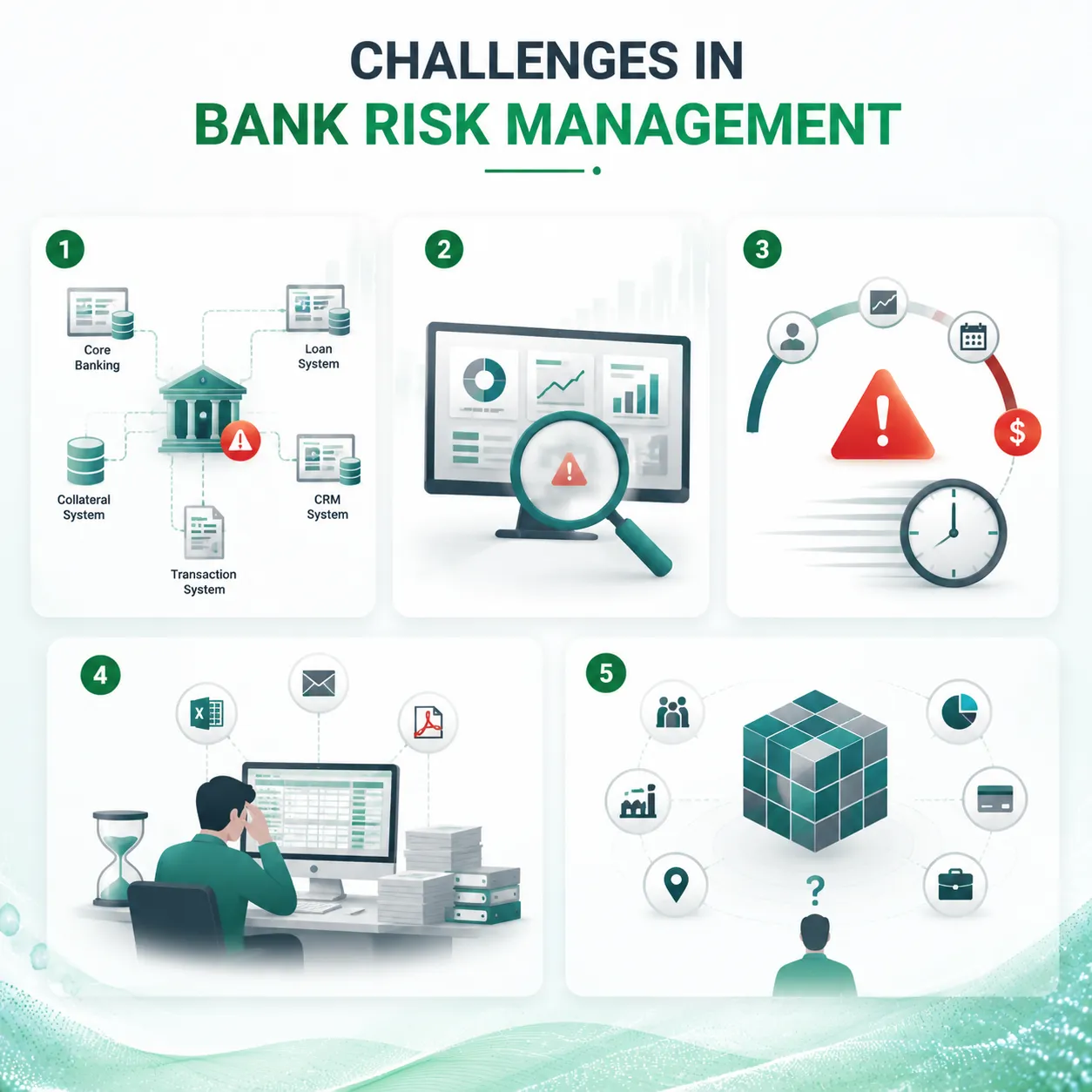
Challenges in Banking Risk Management
Many banks face difficulties in managing and analyzing risk due to limitations in data availability, analytics capabilities, and operational processes.
Common challenges include:
- Risk data is fragmented across multiple banking systems:
Customer information, loan data, collateral data, and transaction records are stored separately, making it difficult to build a complete risk view. - Limited visibility into credit portfolio quality:
Risk teams often lack near real-time monitoring capabilities to identify deteriorating loan quality or emerging risk trends. - Delayed risk identification and response:
Without effective early warning mechanisms, potential credit risks are often detected only after problems have already occurred. - Heavy dependency on manual reporting processes:
Risk analysis and reporting require significant time for data consolidation, reducing the speed of decision-making. - Difficulty analyzing risk drivers from multiple perspectives:
Banks need deeper insights across customer segments, industries, regions, products, and portfolio characteristics to understand risk impacts.
Risk Analytics Platform helps banks overcome these challenges by creating a unified risk analytics foundation and enabling proactive risk management.
Risk Analytics Platform Solutions
Centralized Risk Data Platform
INDA builds a centralized risk data platform that consolidates customer data, loan information, collateral records, transaction data, and credit history from multiple banking systems.
The platform standardizes risk-related data and creates a reliable foundation for credit risk analytics, reporting, and AI-powered risk management.
Business Benefits:
- Consolidate fragmented risk data into a unified platform.
- Improve accuracy and consistency of risk reports and metrics.
- Reduce time required for data preparation and risk analysis.
- Build a strong foundation for Risk Analytics and AI applications.
Credit Portfolio Monitoring
Risk Analytics Platform provides interactive dashboards that enable banks to monitor credit portfolio performance across multiple dimensions, including products, industries, customer segments, regions, and risk levels.
Risk teams and executives can gain a comprehensive view of overall portfolio health, enabling them to detect emerging issues earlier and act proactively.
Business Benefits:
- Monitor credit portfolio quality and risk exposure continuously.
- Detect early signs of deterioration across customers, industries, or products.
- Evaluate the effectiveness of credit policies.
- Support timely risk management decisions.
Early Warning Risk Detection System
Risk Analytics Platform provides interactive dashboards that enable banks to monitor credit portfolio performance across multiple dimensions, including products, industries, customer segments, regions, and risk levels.
Risk teams and executives can gain a comprehensive view of portfolio health, enabling them to identify and address emerging risks much earlier.
Business Benefits:
- Monitor credit portfolio quality and risk exposure continuously.
- Detect early signs of deterioration across customers, industries, or products.
- Evaluate the effectiveness of credit policies.
- Support timely risk management decisions.
Risk Indicator Analytics
The solution enables banks to analyze key risk indicators, evaluate portfolio trends, and leverage data analytics for risk forecasting and strategic planning.
By transforming risk data into actionable insights, banks can improve their ability to anticipate and manage potential risks.
Business Benefits:
- Deliver deeper visibility into complex risk conditions and underlying portfolio trends.
- Support risk teams in thoroughly evaluating and maintaining credit portfolio quality.
- Strengthen predictive capabilities to enable faster, more accurate risk forecasting and proactive issue prevention.
- Drive data-driven credit risk strategies to optimize overall financial decision-making.
Dashboard & Decision Support
INDA delivers risk management dashboards that provide executives and Risk Teams with centralized visibility into key risk indicators, alerts, and performance metrics.
The solution enables faster access to critical information and supports multi-dimensional risk analysis.
Business Benefits:
- Provide a comprehensive view of enterprise risk conditions.
- Reduce time required to access risk information.
- Support scenario analysis and risk evaluation.
- Promote data-driven risk management practices.
Risk Explainability & Audit
The solution provides explainability capabilities to help banks understand risk signals, track analytical logic, and maintain complete records of risk assessment processes.
This ensures transparency and control when applying analytics and AI in risk management.
Business Benefits:
- Understand the underlying reasons behind risk alerts.
- Improve transparency in risk evaluation and decision-making.
- Support internal audits, regulatory reviews, and compliance requirements.
- Ensure effective governance of Analytics and AI applications.
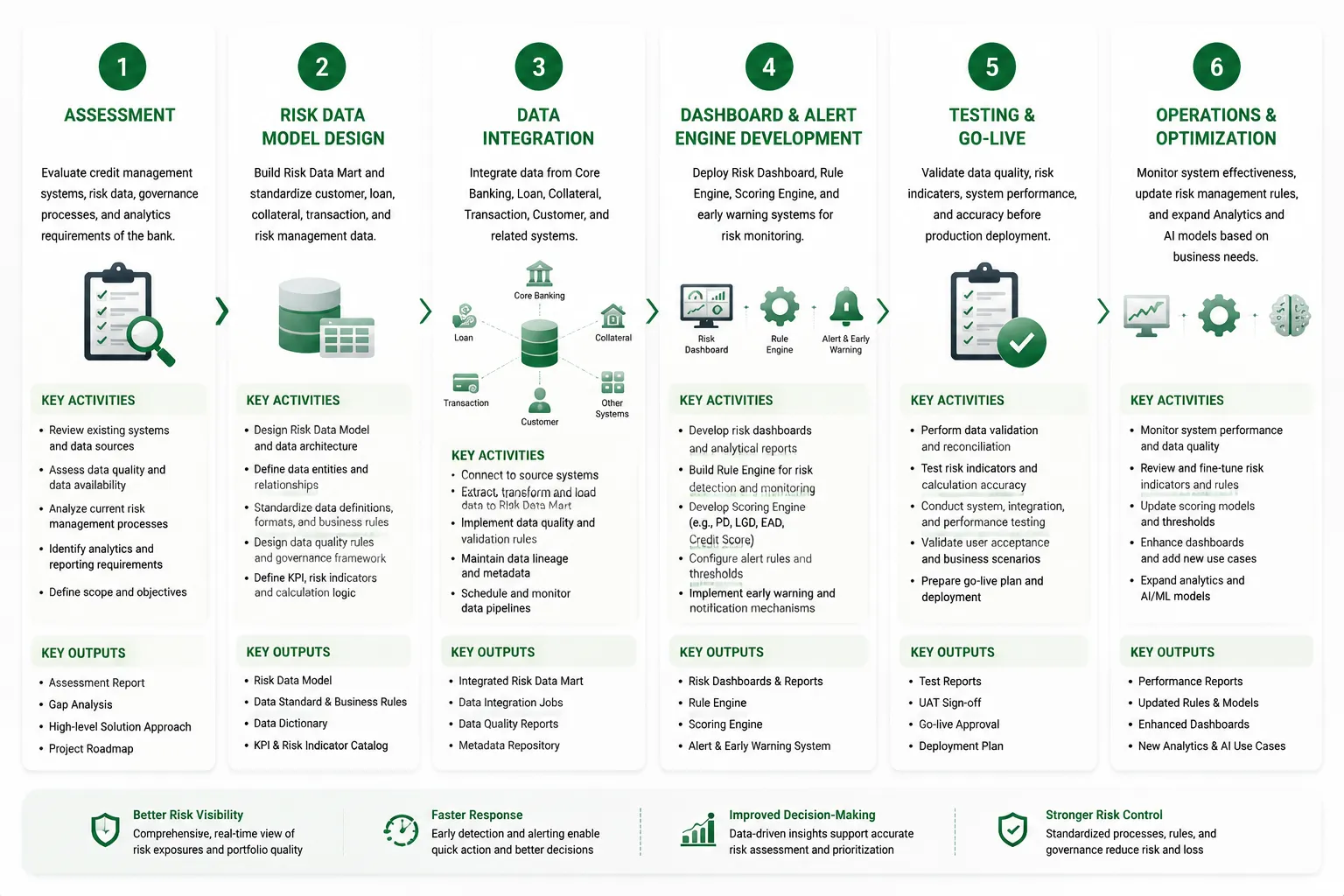
Risk Analytics Platform Implementation Process
INDA applies a structured implementation methodology to help banks deploy Risk Analytics Platform effectively while ensuring alignment with existing technology environments and risk management objectives.
Why Choose INDA for Risk Analytics Platform Implementation?
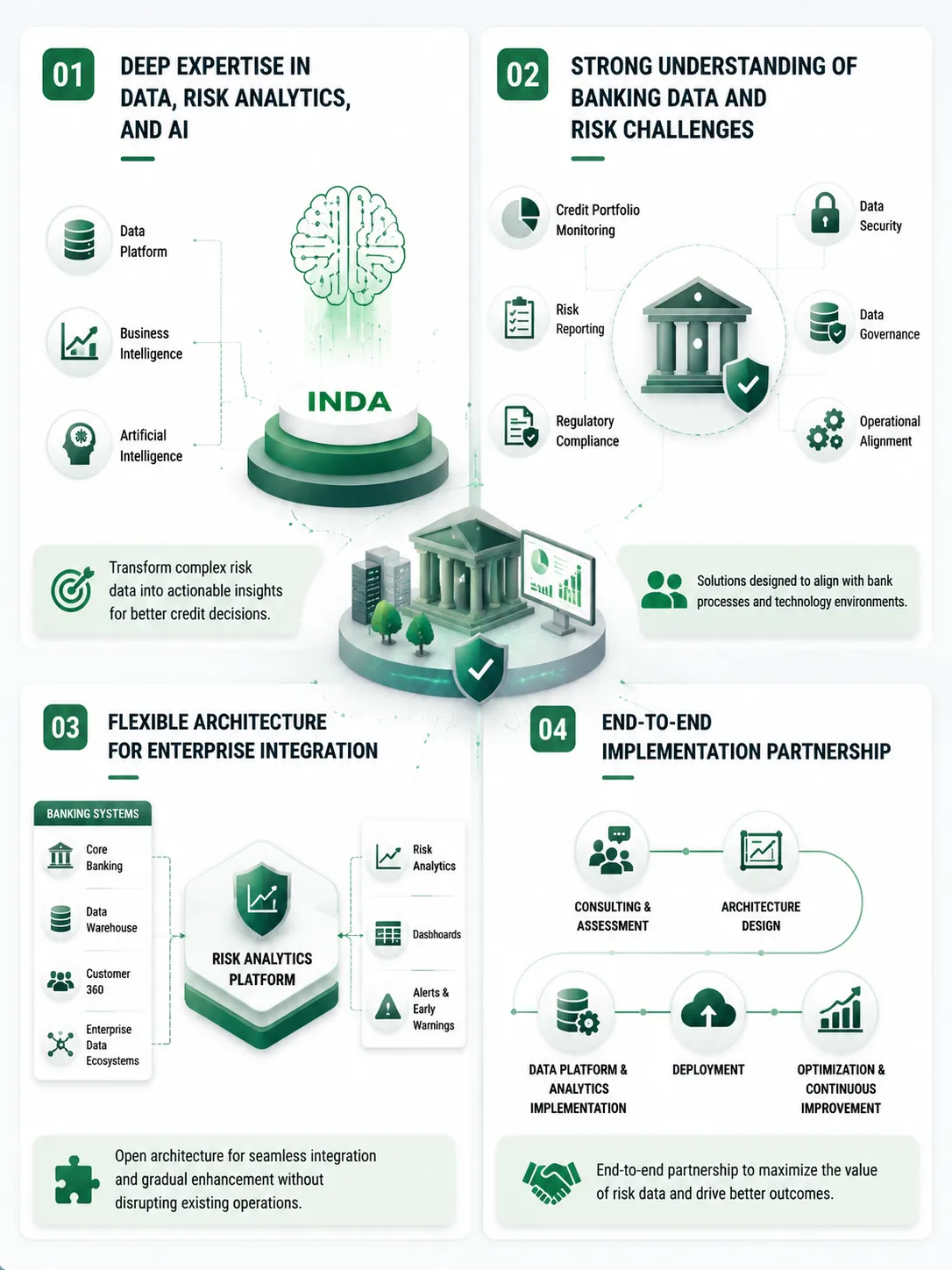
1. Deep Expertise in Data, Risk Analytics, and AI
INDA combines expertise in Data Platform, Business Intelligence, Analytics, and Artificial Intelligence to help banks build modern, data-driven risk management capabilities.
Our experience enables financial institutions to transform complex risk data into actionable insights for better credit decisions.
2. Strong Understanding of Banking Data and Risk Management Challenges
INDA understands the complex requirements of banking risk management, including credit portfolio monitoring, risk reporting, regulatory compliance, data security, and governance.
We help banks design solutions that align with their operational processes and technology environments.
3. Flexible Architecture for Enterprise Integration
Risk Analytics Platform is designed with an open architecture that enables seamless integration with existing banking systems, including Core Banking, Data Warehouse, Customer 360 platforms, and enterprise data ecosystems.
This allows banks to gradually enhance risk analytics capabilities without disrupting existing operations.
4. End-to-End Implementation Partnership
INDA provides comprehensive services from consulting and architecture design to data platform development, analytics implementation, deployment, and optimization.
We support banks throughout their transformation journey to maximize the value of risk data.
Frequently Asked Questions (FAQ)
1. Why do banks still struggle to identify credit risks early despite having large amounts of data?
Many banks collect significant volumes of customer, transaction, and loan data across different systems. However, fragmented data sources, delayed reporting processes, and limited analytical capabilities make it difficult to detect early warning signals before credit quality deteriorates.
Without timely risk visibility, banks may only recognize problems after loans become overdue or customers show significant financial stress, increasing the risk of credit losses.
2. How can banks overcome fragmented risk data across multiple systems?
Risk management requires a comprehensive view of customers, loans, collateral, and transactions. However, this information is often distributed across Core Banking, Loan Management Systems, CRM, and other operational platforms.
When risk teams need to manually consolidate data from multiple sources, analysis becomes time-consuming and the accuracy of risk assessments can be affected.
A centralized and well-governed risk data foundation helps banks create a consistent view of risk exposure and improve the effectiveness of risk management processes.
3. Why do risk teams still depend heavily on manual reports for credit portfolio monitoring?
Many banks rely on periodic reports to review portfolio performance, overdue loans, and risk indicators. However, manual reporting processes often require significant time for data preparation and may not provide sufficient visibility into rapidly changing risk conditions.
As market conditions and customer behaviors change quickly, risk teams need more timely insights to monitor portfolio quality and take proactive actions.
4. Why is it difficult for banks to build an effective early warning system for credit risks?
Early risk detection requires the ability to identify changes in customer behavior, repayment patterns, transaction activities, and portfolio trends.
However, many banks face challenges in defining meaningful risk indicators, connecting data from different sources, and continuously monitoring potential warning signals.
Without an effective early warning capability, risk management often becomes reactive rather than proactive.
5. How can banks improve transparency and accuracy in risk management decisions?
Risk decisions increasingly require clear explanations of why a customer, loan, or portfolio is considered high risk.
However, when risk analysis relies on multiple reports, disconnected data sources, or complex analytical models, it can be difficult for stakeholders to understand the underlying reasons behind risk signals.
Banks need transparent analytics capabilities that help Risk Teams, management, and auditors understand risk drivers and support more confident decision-making.
6. How can banks strengthen risk governance while adopting advanced analytics and AI?
As banks increasingly adopt Analytics and AI for risk management, they must also ensure data security, regulatory compliance, and proper governance.
Challenges such as controlling data access, maintaining audit trails, and explaining analytical results become critical when applying AI in sensitive areas like credit risk.
A strong combination of Data Governance, analytics capabilities, and risk management processes enables banks to adopt advanced technologies while maintaining control and compliance.
Contact INDA today to explore a Risk Analytics solution tailored to your bank’s risk management strategy and digital transformation goals.


