

Building a Transparent, Consistent, and Trusted Data Management Foundation
In the data-driven era, the ability to effectively manage, access, and utilize data has become a critical factor in improving operational efficiency, enabling better decision-making, and accelerating digital transformation.
However, as enterprise data continues to grow across multiple systems, departments, applications, and platforms, organizations are facing increasing challenges in maintaining data consistency, ensuring data quality, identifying trusted data sources, and establishing clear ownership of data assets.
INDA provides comprehensive Data Governance solutions that help enterprises establish a structured approach to managing their data assets through Data Governance Framework development, Metadata Management, Data Catalog implementation, Data Quality Management, Master Data Management (MDM), and Data Lineage tracking.
With extensive experience in data consulting and implementation, INDA helps organizations standardize their data assets, improve data reliability, and build a strong foundation for Business Intelligence (BI), Advanced Analytics, and Artificial Intelligence (AI) initiatives.
Enterprise Data Governance Challenges
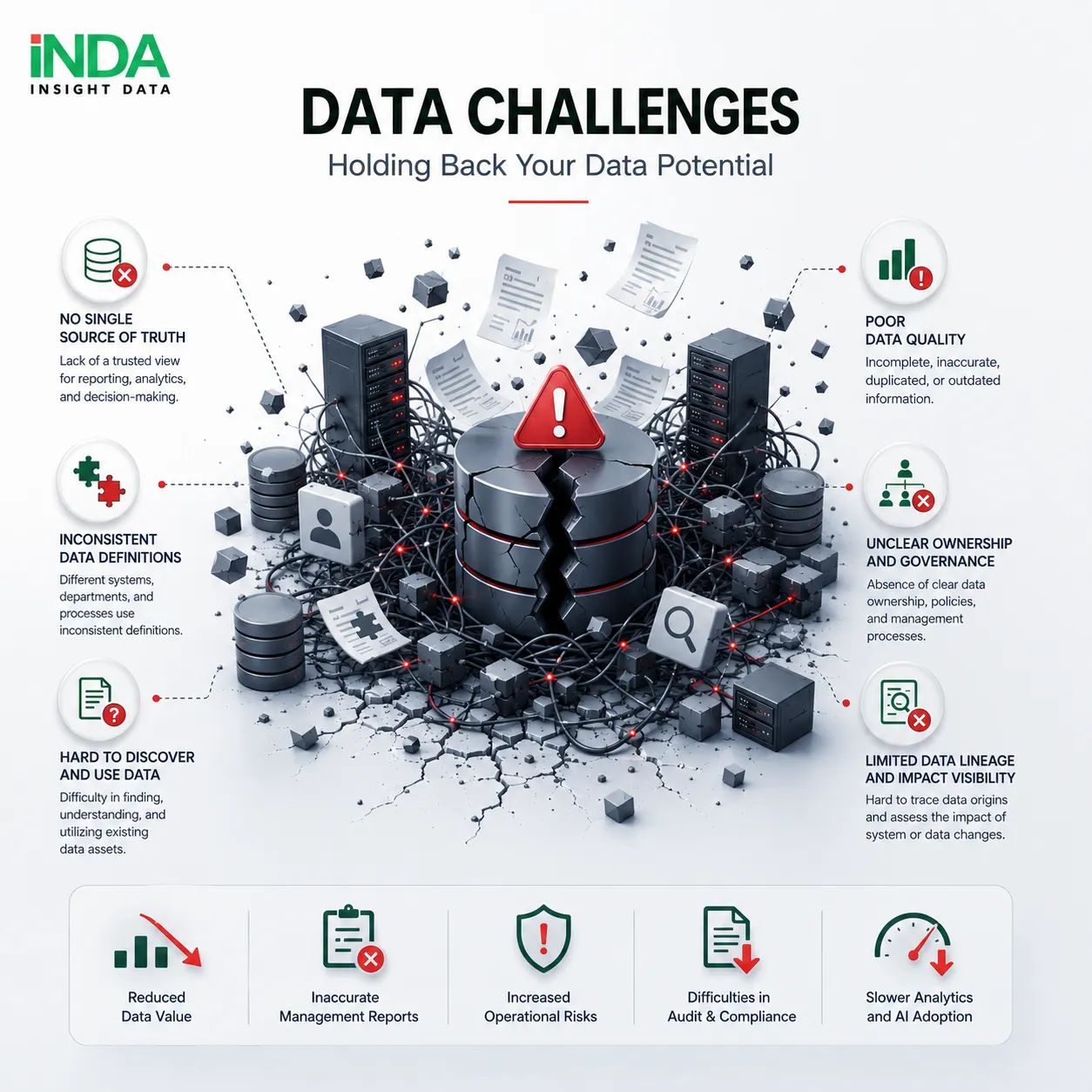
As enterprise data grows in volume, complexity, and distribution, organizations often struggle with multiple data management challenges:
- Lack of a trusted Single Source of Truth for reporting, analytics, and business decision-making.
- Inconsistent data definitions across different systems, departments, and business processes.
- Poor data quality caused by incomplete, inaccurate, duplicated, or outdated information.
- Difficulty discovering, understanding, and effectively utilizing existing data assets.
- Absence of clear data ownership, governance policies, and management processes.
- Limited ability to trace data origins and assess the impact of system or data changes.
These challenges reduce the value of enterprise data, affect the accuracy of management reports, increase operational risks, and create difficulties in meeting audit and regulatory compliance requirements.
A well-designed Data Governance strategy enables organizations to transform fragmented data into a trusted, controlled, and valuable enterprise asset.
INDA Data Governance Solutions
Data Governance Framework
INDA helps enterprises build a structured Data Governance Framework with clear policies, roles, and processes for effective data management.
The solution enables organizations to establish data ownership models, define governance standards, and improve business-IT collaboration to ensure consistent data management across the enterprise.
Key Benefits:
- Establish a structured enterprise data governance model.
- Standardize data policies, processes, and standards.
- Define clear Data Owner and Data Steward responsibilities.
- Reduce data risks and improve compliance readiness.
Master Data Management (MDM)
INDA’s Master Data Management (MDM) solution helps enterprises create a trusted source of critical business data, including customer, product, supplier, and organizational information.
By eliminating duplicated and inconsistent records across different systems, MDM ensures business functions can access accurate and consistent data for better operations and decision-making.
Key Benefits:
- Build a trusted Single Source of Truth for business data.
- Eliminate duplicate and inconsistent records.
- Create standardized Golden Records.
- Improve data integration and operational efficiency.
Data Quality Management
INDA provides Data Quality Management solutions that help organizations monitor, control, and improve the accuracy and reliability of enterprise data.
The solution helps detect issues such as missing information, incorrect formats, duplicate records, and inconsistent data, ensuring data can be trusted for reporting, analytics, and AI applications.
Key Benefits:
- Continuously monitor enterprise data quality.
- Detect and resolve inaccurate or incomplete data.
- Standardize data according to business requirements.
- Improve confidence in reporting and analytics results.
Metadata Management
INDA’s Metadata Management solution helps enterprises manage data descriptions, business definitions, structures, and relationships across multiple data sources.
By creating a common understanding of enterprise data, organizations can improve data discovery, reduce misunderstanding between teams, and enhance the effectiveness of data management activities.
Key Benefits:
- Standardize metadata across enterprise systems.
- Maintain consistent business definitions and terminology.
- Improve data understanding and accessibility.
- Support effective data governance practices.
Data Catalog
INDA’s Data Catalog solution enables enterprises to build a centralized inventory of data assets, helping users easily search, discover, and understand available data.
The solution improves data accessibility by allowing business users to identify relevant datasets, understand their meaning, and utilize trusted information more effectively.
Key Benefits:
- Centralize management of enterprise data assets.
- Improve data discovery and accessibility.
- Enable data sharing and reuse across teams.
- Reduce time spent searching for data.
Data Lineage
INDA’s Data Lineage solution provides visibility into the complete lifecycle of enterprise data, from original sources and transformations to reports and analytical applications.
The solution helps organizations understand data origins, track data movement, assess change impacts, and improve transparency for audit and compliance requirements.
Key Benefits:
- Track data origins and movement across systems.
- Understand data transformation processes.
- Assess impacts of system and data changes.
- Improve transparency and compliance control.
Data Governance Implementation Process
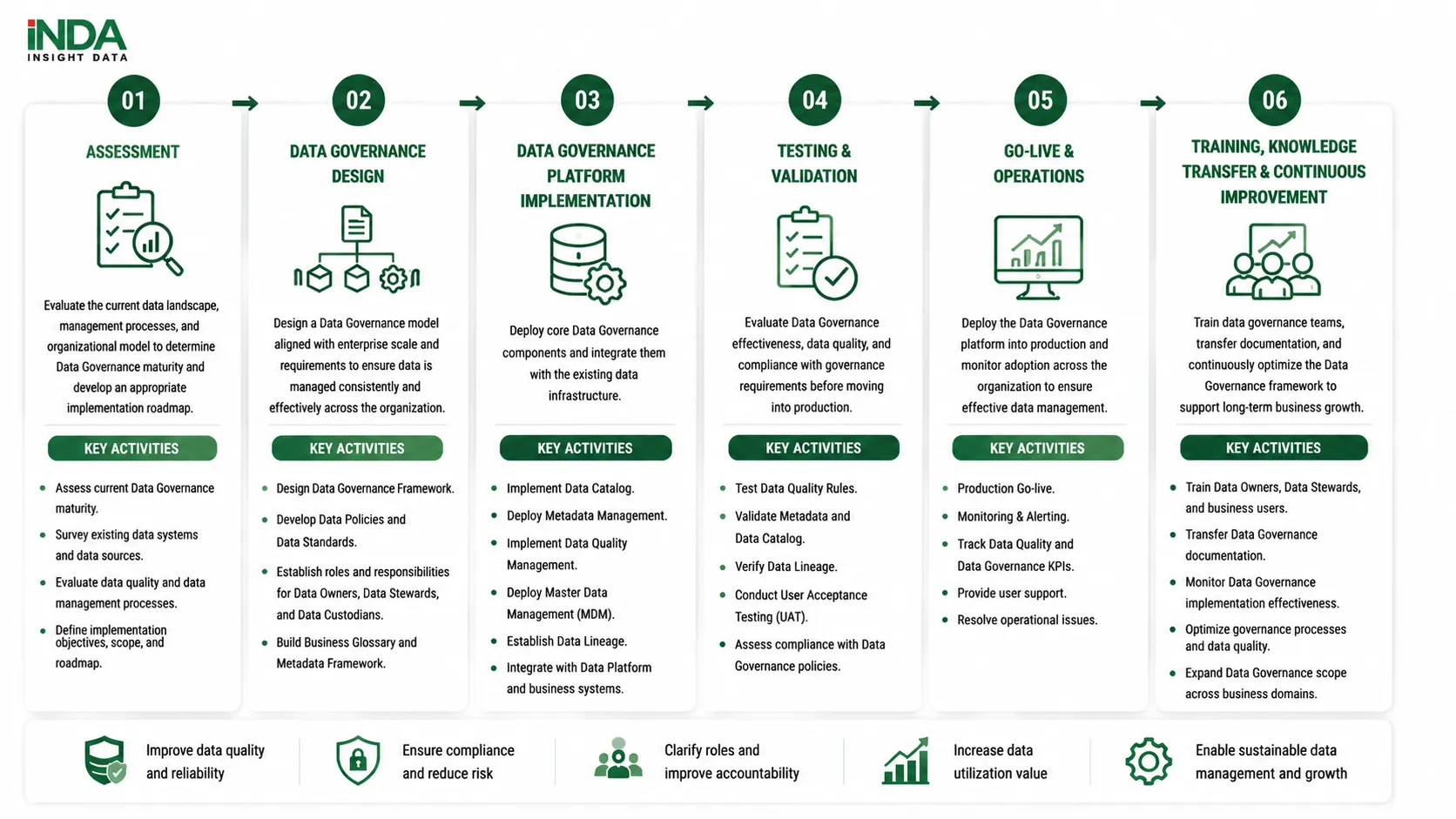
INDA follows a structured Data Governance implementation approach to help enterprises establish effective data management practices, improve data reliability, and ensure long-term governance capabilities.
Each implementation phase is designed to align data governance objectives with business requirements, existing data environments, and organizational operating models.
Why Choose INDA for Data Governance Implementation?
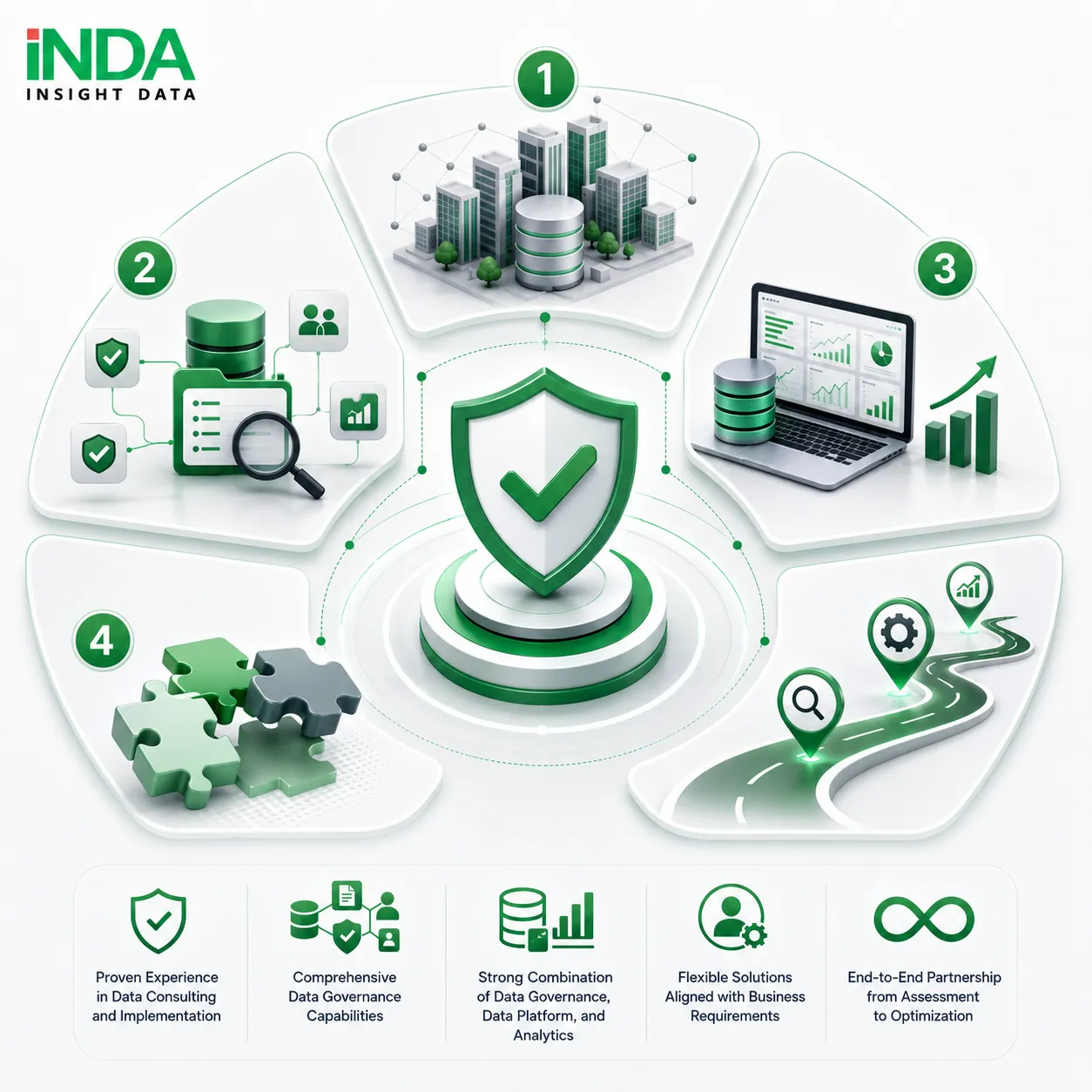
1. Proven Experience in Data Consulting and Implementation
INDA has experience supporting enterprises with complex data environments in building effective data management and governance capabilities.
2. Comprehensive Data Governance Capabilities
INDA provides end-to-end Data Governance solutions, covering governance frameworks, Data Catalog, Data Quality, Metadata Management, Master Data Management, and Data Lineage.
3. Strong Combination of Data Governance, Data Platform, and Analytics
INDA helps organizations connect Data Governance initiatives with modern data platforms and analytics solutions to maximize business value from data.
4. Flexible Solutions Aligned with Business Requirements
INDA designs Data Governance approaches that fit each organization’s operational model, compliance requirements, and digital transformation objectives.
5. End-to-End Partnership from Assessment to Optimization
INDA supports enterprises throughout the entire journey, from current-state assessment and governance design to implementation and continuous improvement.
Frequently Asked Questions (FAQ)
1. Why do different departments often have different reports for the same business metric?
When organizations lack standardized data governance practices, different departments may use different data sources, KPI definitions, and calculation methods, resulting in inconsistent reports.
INDA helps enterprises establish Data Governance Frameworks, Business Glossaries, and Data Standards to ensure data is consistently defined and used across the organization.
2. How can enterprises identify which data source is reliable for reporting and decision-making?
With data distributed across multiple systems, organizations often struggle to determine which data source should be trusted as the official reference.
INDA’s Data Governance solutions help enterprises manage Data Catalog, Metadata, and Data Lineage, providing better visibility into data sources, definitions, and reliability.
3. Who is responsible when data quality issues occur?
Without clear ownership models, organizations may struggle to identify who is responsible for managing, validating, and improving specific data assets.
INDA helps enterprises establish Data Owner and Data Steward roles, creating clear accountability throughout the data lifecycle.
4. How can enterprises manage sensitive data and meet compliance requirements?
As customer, financial, and business data continues to grow, organizations need better control over where data is stored, who can access it, and how it is used.
INDA helps implement Data Governance practices that support data classification, metadata management, access control, and compliance requirements.
5. Why do some BI and AI initiatives fail despite having advanced technologies?
Many Analytics and AI projects fail because the underlying data is incomplete, inconsistent, or unreliable rather than because of technology limitations.
INDA helps enterprises establish strong Data Governance foundations through Data Quality Management, Master Data Management, and Data Lineage to ensure data readiness for BI, Analytics, and AI.
Contact INDA to receive consultation on a suitable Data Governance solution aligned with your organization’s data strategy, operational requirements, and digital transformation goals.


