

Building a Trusted Data Foundation for Banking Data Management and AI Transformation
As digital transformation accelerates, data has become a critical foundation for banks to improve operational efficiency, strengthen risk management, and enable advanced Analytics and AI applications.
However, many banks still struggle to effectively manage their data assets. Data is often distributed across multiple business systems, lacks standardized definitions, has limited traceability, and is managed without clear ownership and governance processes.
These challenges make it difficult for banks to identify trusted data sources for reporting, maintain data quality, comply with regulatory requirements, and maximize the value of existing data assets.
Data Catalog & Data Governance provided by INDA helps banks establish a comprehensive data management foundation through Metadata Management, Business Glossary, Data Lineage, Data Quality Management, Data Classification, and Governance Workflows.
The solution enables organizations to understand what data they have, where data comes from, how data is used, who is responsible for managing it, and how to ensure data remains accurate, transparent, and trustworthy for business operations, Analytics, and AI initiatives.
Challenges in Banking Data Governance
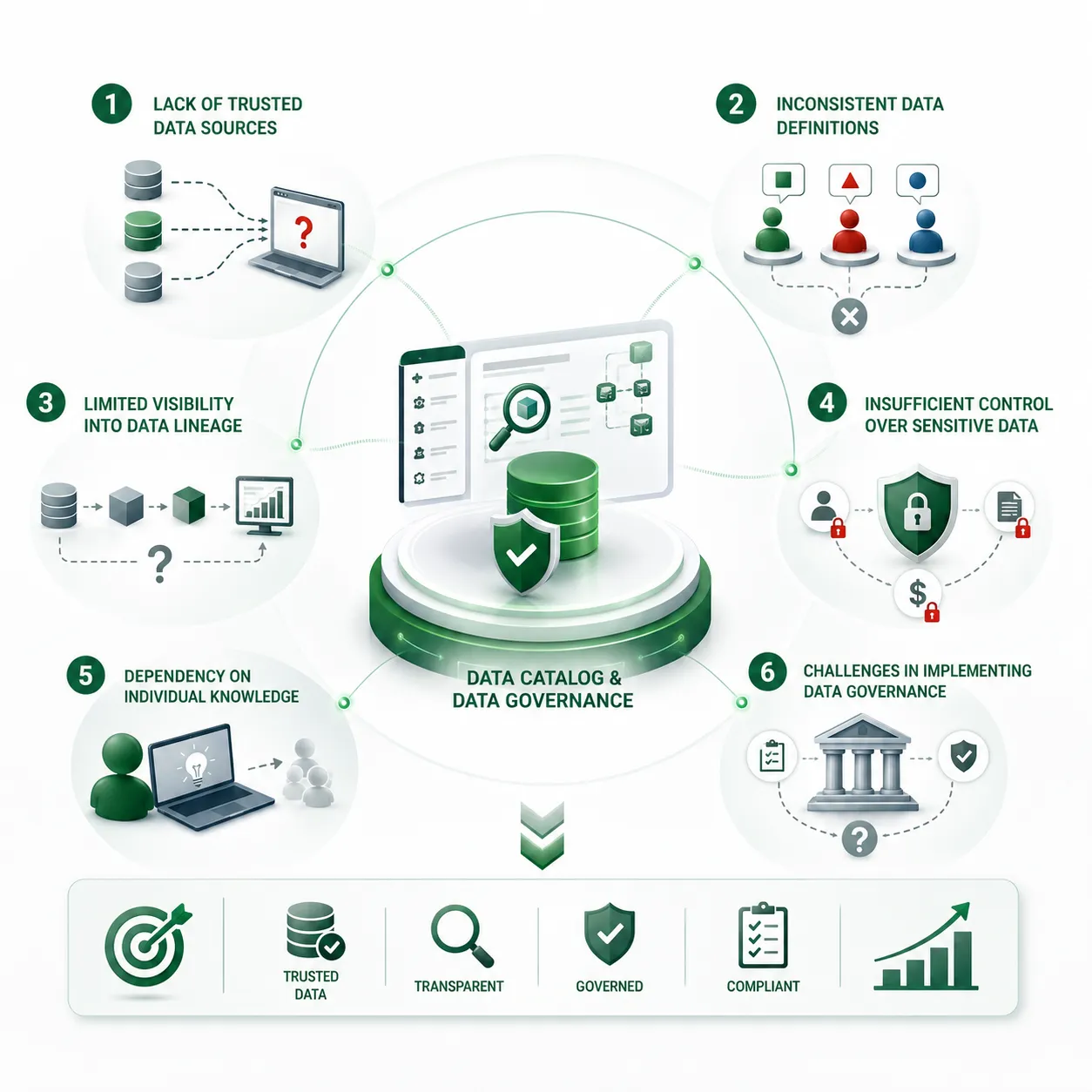
Many banks face increasing challenges in managing and utilizing enterprise data due to:
- Lack of trusted data sources (Single Source of Truth):
Banks often have multiple systems containing similar data, making it difficult to determine which source should be used for reporting and decision-making. - Inconsistent data definitions across departments:
Different business units may use different interpretations of the same data elements, resulting in inconsistent reports and analytics outcomes. - Limited visibility into data lineage:
Banks often struggle to trace how data moves from source systems through ETL processes to dashboards, reports, and analytical applications. - Insufficient control over sensitive data:
Customer information (PII), financial data, and confidential information require stronger classification, protection, and access control mechanisms. - Dependency on individual knowledge:
Data users often rely on specific employees’ experience to understand data meaning, location, and usage. - Challenges in implementing Data Governance:
Banks need structured governance frameworks to support auditing, compliance, and enterprise-wide data management.
Data Catalog & Data Governance helps banks overcome these challenges by creating a transparent, governed, and trusted data ecosystem.
Risk Analytics Platform Solutions
Metadata Management & Business Glossary
INDA implements comprehensive Metadata Management, Business Glossary, and Data Dictionary capabilities to standardize data definitions and establish a unified, common understanding of enterprise data.
The solution empowers both business and IT teams to clearly understand data meaning, relationships, ownership, and usage across the entire organization.
Business Benefits:
- Create a unified data definition repository across business and IT teams.
- Help users easily search, understand, and utilize trusted data.
- Reduce reporting inconsistencies caused by different data interpretations.
- Improve data sharing and reuse across departments.
Data Lineage
Data Lineage enables banks to track the complete, end-to-end journey of data as it flows from core source systems, through complex ETL/ELT pipelines, to final regulatory reports, dashboards, and advanced AI applications.
This delivers granular enterprise transparency into how data is transformed, validated, and consumed, ensuring complete auditability, simplified compliance, and absolute confidence in business decision-making.
Business Benefits:
- Improve visibility into data origins and transformation processes.
- Quickly identify root causes when data quality issues occur.
- Assess the impact of system or process changes.
- Support auditing and improve confidence in business reports.
Data Classification & Sensitive Data Management
The solution helps banks classify and manage data based on importance and sensitivity levels, including customer information (PII), financial data, and other regulated information.
This enables organizations to establish appropriate protection and access control policies.
Business Benefits:
- Identify and centrally manage sensitive data assets.
- Support data protection and access control policies.
- Reduce risks of data leakage or unauthorized usage.
- Improve compliance with security and regulatory requirements.
Data Governance Workflow
INDA helps banks establish structured Data Governance workflows by defining roles such as Data Owner and Data Steward, approval processes, data change management, and quality control procedures.
This creates clear accountability and consistent governance practices across the organization.
Business Benefits:
- Define clear responsibilities for enterprise data management.
- Standardize data governance processes and operations.
- Improve data consistency and reliability.
- Build a scalable foundation for enterprise-wide Data Governance.
Metadata Harvesting & Integration
The solution automatically collects metadata from existing data environments, including databases, ETL/ELT platforms, BI systems, Data Warehouses, Data Lakes, and enterprise data platforms.
This enables organizations to build a centralized metadata repository without relying on manual documentation.
Business Benefits:
- Automate metadata collection and maintenance.
- Reduce dependency on manual data documentation.
- Improve visibility into enterprise data assets.
- Support future expansion of the data ecosystem.
Data Quality & Governance Monitoring
INDA provides comprehensive, real-time dashboards to monitor data quality performance and track Data Governance compliance across the organization.
This clear visibility empowers banks to proactively identify, analyze, and resolve data-related issues before they impact business decisions.
Business Benefits:
- Monitor data quality based on defined business rules and standards.
- Detect data issues affecting reports and analytics.
- Evaluate Data Governance implementation effectiveness.
- Maintain accurate, consistent, and trusted enterprise data.
Data Catalog & Data Governance Implementation Process
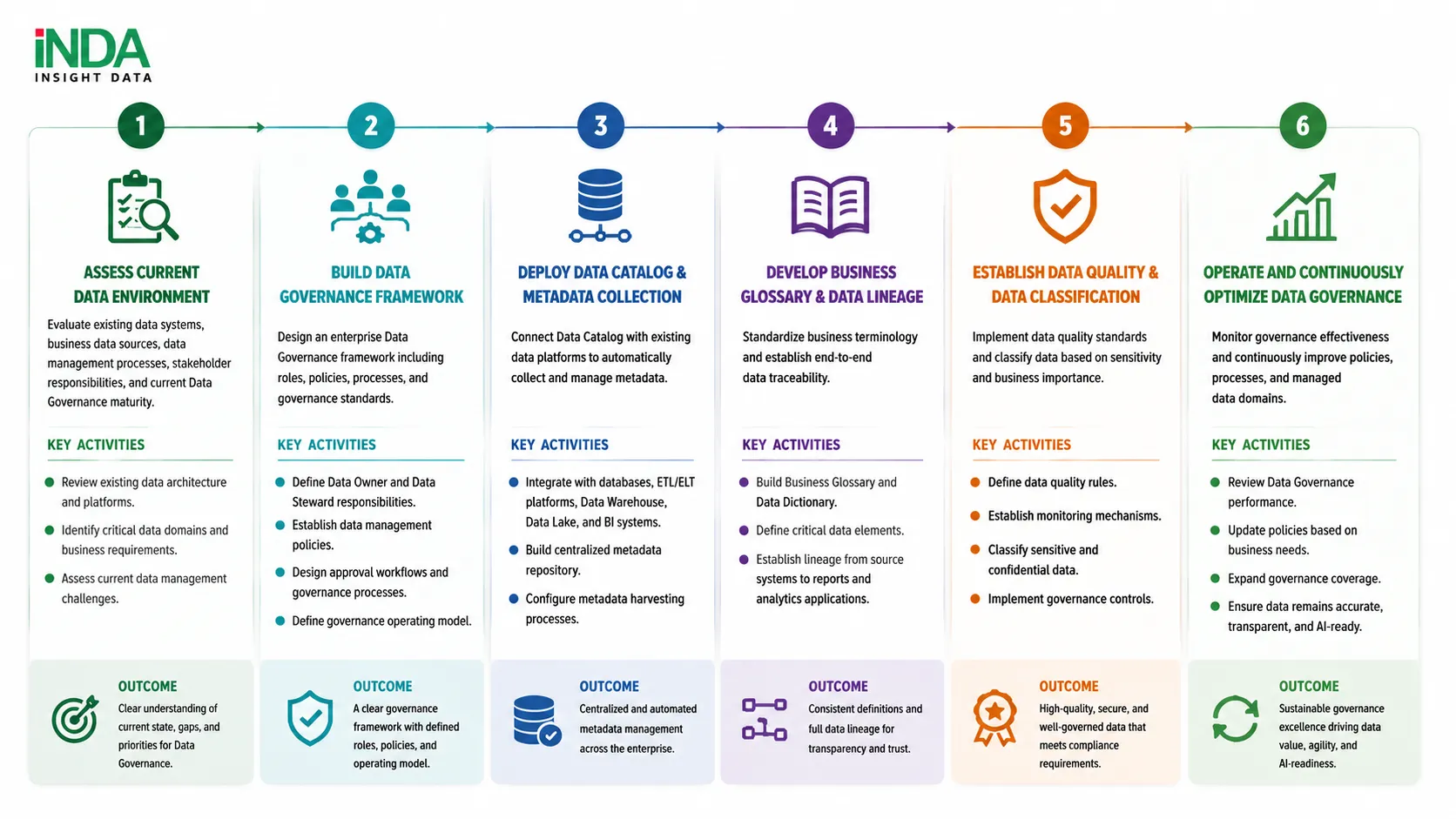
INDA applies a structured approach to help banks establish Data Governance capabilities aligned with their operating model, technology architecture, and data transformation objectives.
Why Choose INDA for Data Catalog & Data Governance Implementation?
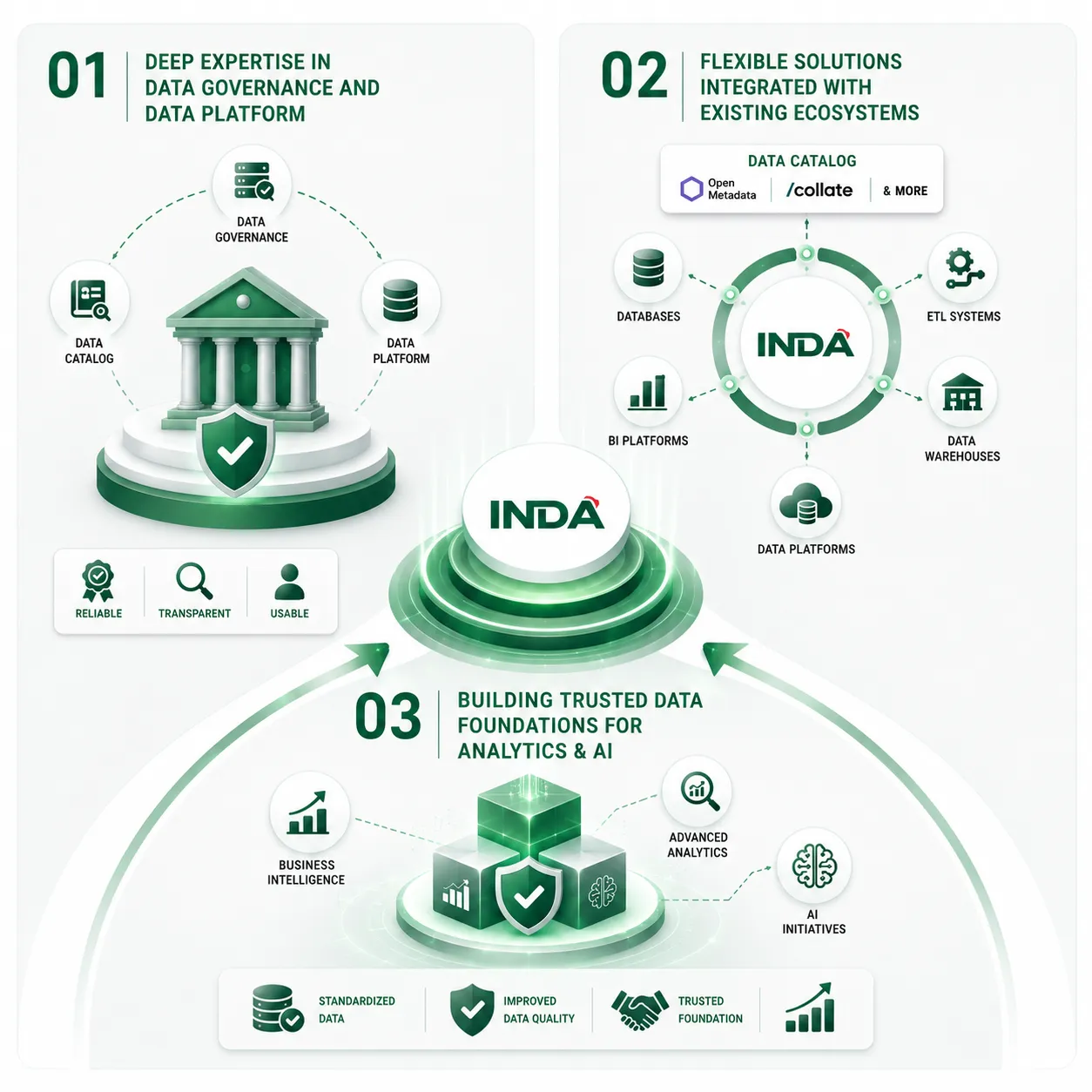
1. Deep Expertise in Data Governance and Data Platform
INDA has extensive experience in consulting and implementing Data Governance, Data Catalog, and Data Platform solutions for financial organizations.
Our expertise helps banks establish effective data management foundations to improve data reliability, transparency, and usability.
2. Flexible Solutions Integrated with Existing Data Ecosystems
INDA implements Data Catalog solutions based on modern platforms such as OpenMetadata, GetCollate, and equivalent technologies, enabling integration with existing databases, ETL systems, BI platforms, Data Warehouses, and Data Platforms.
This approach allows banks to enhance Data Governance capabilities without disrupting existing technology environments.
3. Building Trusted Data Foundations for Analytics & AI
INDA helps banks standardize data, improve data quality, and establish trusted information foundations required for Business Intelligence, advanced Analytics, and future AI initiatives.
Frequently Asked Questions (FAQ)
1. Why do banks still struggle to effectively use their data despite having large amounts of information?
Many banks generate massive volumes of data from Core Banking, CRM, lending systems, transactions, and analytical platforms. However, data is often fragmented, inconsistently defined, and managed without clear ownership.
As a result, business users may spend significant time searching for data, validating information, or resolving inconsistencies before they can use data for reporting and decision-making.
2. How can banks determine which data source is accurate and trustworthy?
Banks often have multiple systems storing similar information, making it difficult to identify the official source for reporting and analytics.
Without clear metadata, ownership, and lineage information, users may rely on incorrect or outdated data, affecting business decisions.
A structured approach to Data Catalog and Data Governance helps organizations understand data origin, meaning, ownership, and reliability.
3. Why do banks need Data Governance when they already have Data Platforms?
A Data Platform helps organizations store and process data, but it does not automatically ensure that data is accurate, consistent, well-defined, or properly managed.
Data Governance provides the policies, responsibilities, and processes needed to maintain data quality, establish ownership, and ensure data is effectively managed across the organization.
4. Why is it difficult for banks to trace data from source systems to reports and dashboards?
Modern banking environments involve complex data flows across Core Banking, ETL processes, Data Warehouses, BI platforms, and analytical applications.
Without Data Lineage capabilities, banks may struggle to identify where data comes from, how it has been transformed, or why inconsistencies appear in reports.
5. How can banks manage sensitive data while expanding Analytics and AI adoption?
As banks increase data usage for Analytics and AI, protecting sensitive information such as customer data and financial records becomes increasingly important.
Without proper classification, access control, and governance mechanisms, organizations face higher risks of data misuse and compliance issues.
Data Governance helps banks maintain control, improve transparency, and enable secure data utilization.
Contact INDA today to explore a Data Catalog & Data Governance solution aligned with your bank’s data strategy and digital transformation goals.


