

Unified Data Platform for Modern Enterprise Data Management
As enterprises continue to generate increasing volumes of data from business applications, operational systems, CRM, ERP, digital platforms, and external data sources, managing and extracting value from distributed data has become a major challenge.
Many organizations still struggle with fragmented data environments, complex data integration processes, inconsistent information across systems, and limited capabilities to support advanced analytics and Artificial Intelligence (AI). Traditional data architectures often create barriers when businesses need to process large-scale data, combine different data formats, or accelerate data-driven decision-making.
A Data Lakehouse is a modern data architecture that combines the scalability and flexibility of Data Lake with the governance, reliability, and analytical capabilities of Data Warehouse. This unified approach enables enterprises to store, process, manage, and analyze diverse data types within a single architecture.
INDA provides Data Lakehouse consulting and implementation services, helping enterprises assess their current data environment, design suitable Lakehouse architectures, integrate data sources, build scalable data pipelines, and connect analytics and AI workloads. With experience across commercial and open-source technologies, INDA helps organizations establish a flexible and future-ready data foundation.
Challenges in Enterprise Data Management
Fragmented Data Makes It Difficult to Unlock Business Value
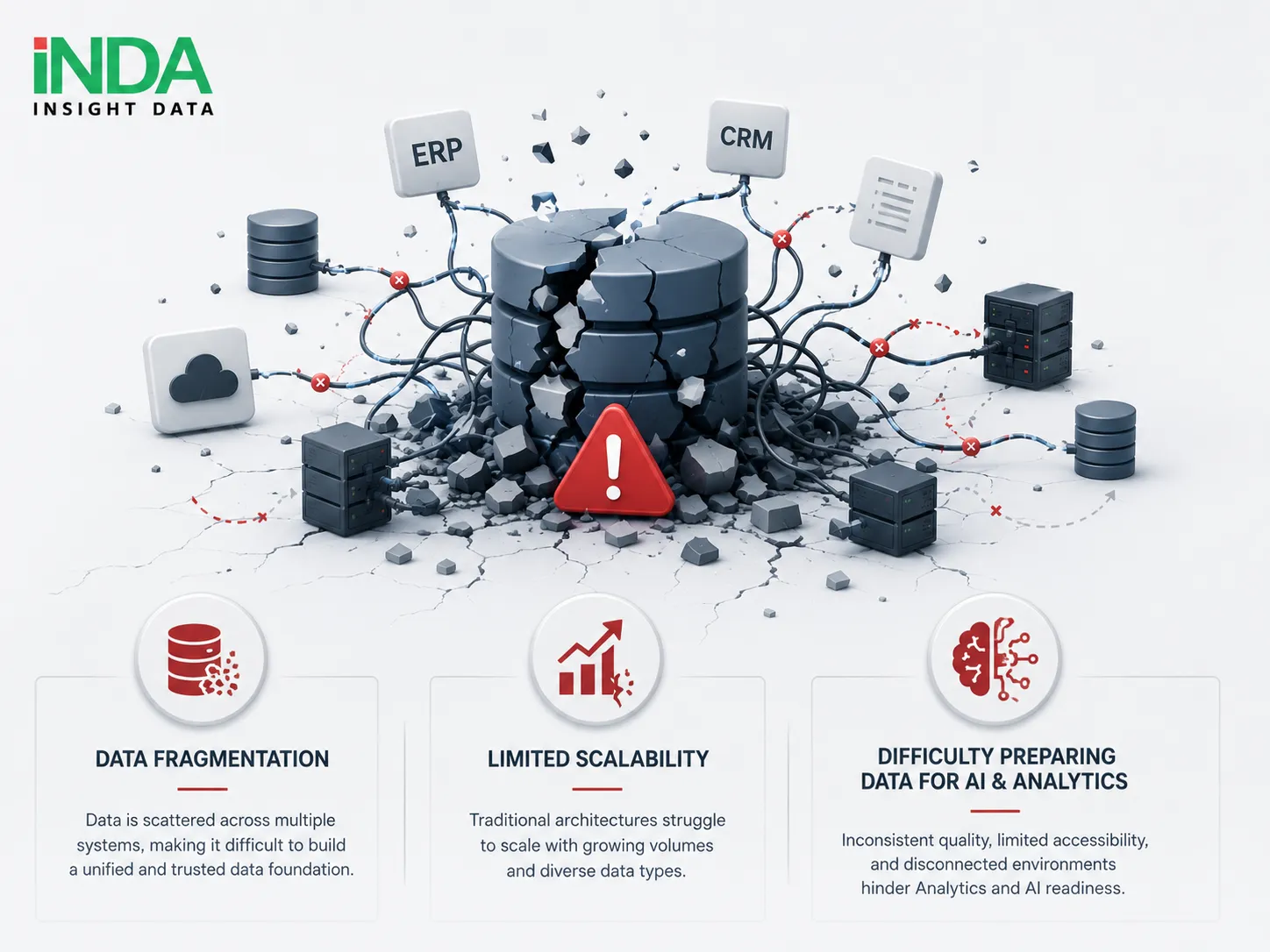
As enterprises generate increasing volumes of data from ERP, CRM, operational systems, digital platforms, and cloud applications, managing and extracting value from data has become increasingly complex.
Common challenges include:
- Data silos across multiple systems make it difficult to integrate, standardize, and build a unified view of enterprise data.
- Limited scalability of traditional data architectures prevents organizations from efficiently handling growing data volumes and diverse data types.
- Data is not ready for Analytics and AI due to inconsistent data quality, complex preparation processes, and limited accessibility.
Without a modern data architecture, enterprises may struggle to accelerate analytics initiatives, improve decision-making, and scale AI adoption
Data Lakehouse – A Modern Foundation for Enterprise Data
Data Lakehouse is a unified data architecture that combines the strengths of Data Lake and Data Warehouse into a single platform.
Instead of maintaining separate systems for data storage, processing, and analytics, Lakehouse enables organizations to:
- Store structured, semi-structured, and unstructured data.
- Manage enterprise data on a centralized platform.
- Support large-scale data analytics workloads.
- Connect seamlessly with BI platforms and AI applications.
Compared with traditional data architectures, Data Lakehouse provides greater flexibility, scalability, and cost efficiency, helping organizations build a future-ready data foundation for advanced analytics and AI adoption.
INDA Data Lakehouse Solutions
1. Comprehensive Lakehouse Consulting and Implementation
INDA provides Data Lakehouse solutions that help organizations modernize their data platforms, integrate fragmented data sources, and build a scalable foundation for advanced analytics.
The solution is designed based on:
- Current data environment.
- Business requirements.
- Security and governance needs.
- Scalability objectives.
- Long-term data strategy.
2. Data Assessment and Architecture Consulting
Before implementation, INDA evaluates the existing data environment to identify:
- Current data sources and systems.
- Existing data architecture.
- Data maturity level.
- Performance and security requirements.
Based on the assessment, INDA recommends an optimized Lakehouse architecture aligned with business objectives and technology capabilities.
3. Data Lakehouse Architecture Design
Data Source
Connect data from:
- Databases.
- Enterprise applications.
- Business systems.
- External data sources.
Data Ingestion
Build scalable data ingestion pipelines using:
- ETL (Extract, Transform, Load).
- ELT (Extract, Load, Transform).
- Batch processing.
- Real-time streaming.
Data Storage
Design flexible storage architectures across:
- Cloud environments.
- On-premise infrastructure.
- Hybrid Cloud models.
Ensuring scalability, cost optimization, and security requirements.
Data Processing
Support:
- Data cleansing.
- Data transformation.
- Data standardization.
- Data preparation for Analytics and AI.
Data Governance
Integrate governance capabilities including:
- Metadata Management.
- Data access control.
- Data Quality Management.
- Data Lineage tracking.
4. Data Pipeline Development and Data Integration
INDA helps organizations build automated data pipelines that enable efficient data collection, processing, and delivery.
Key activities include:
- Connecting data from multiple sources.
- Building automated data pipelines.
- Streamlining data processing workflows.
- Synchronizing data across systems.
5. Analytics, BI, and AI Integration
Data Lakehouse is not only a storage platform but also a foundation for turning enterprise data into actionable insights.
INDA supports integration with:
- Business Intelligence (BI).
- Executive dashboards.
- Advanced Analytics.
- Machine Learning models.
- Generative AI applications.
Helping organizations transform data into business insights and accelerate data-driven decision-making.
6. Lakehouse Optimization and Operation Support
After implementation, INDA supports organizations with:
- System monitoring.
- Data processing optimization.
- Cost management.
- Architecture expansion based on business growth.
Ensuring the Data Lakehouse platform remains efficient, scalable, and aligned with evolving business needs.
Data Lakehouse Platforms INDA Supports
INDA does not limit organizations to a single technology platform. Based on existing infrastructure, business requirements, and data strategy, INDA recommends the most suitable Lakehouse approach.
Oracle Data Lakehouse
Suitable for organizations using the Oracle ecosystem with strong requirements for:
- Enterprise data management.
- Security.
- Integration with existing business systems.
Microsoft Fabric
A unified data platform within the Microsoft ecosystem supporting:
- Data Engineering.
- Analytics.
- Business Intelligence.
- AI workloads.
AWS and Google Cloud Data Lakehouse
INDA supports Lakehouse implementation on major Cloud platforms, including:
- AWS.
- Google Cloud.
Helping organizations leverage cloud scalability, flexibility, and optimized operations.
Open-Source Data Lakehouse
INDA supports open-source Data Lakehouse architectures based on technologies such as:
- Apache Iceberg.
- Apache Spark.
- Trino.
- Airflow.
- dbt.
- MinIO.
Providing flexibility in technology selection based on technical requirements and investment objectives.
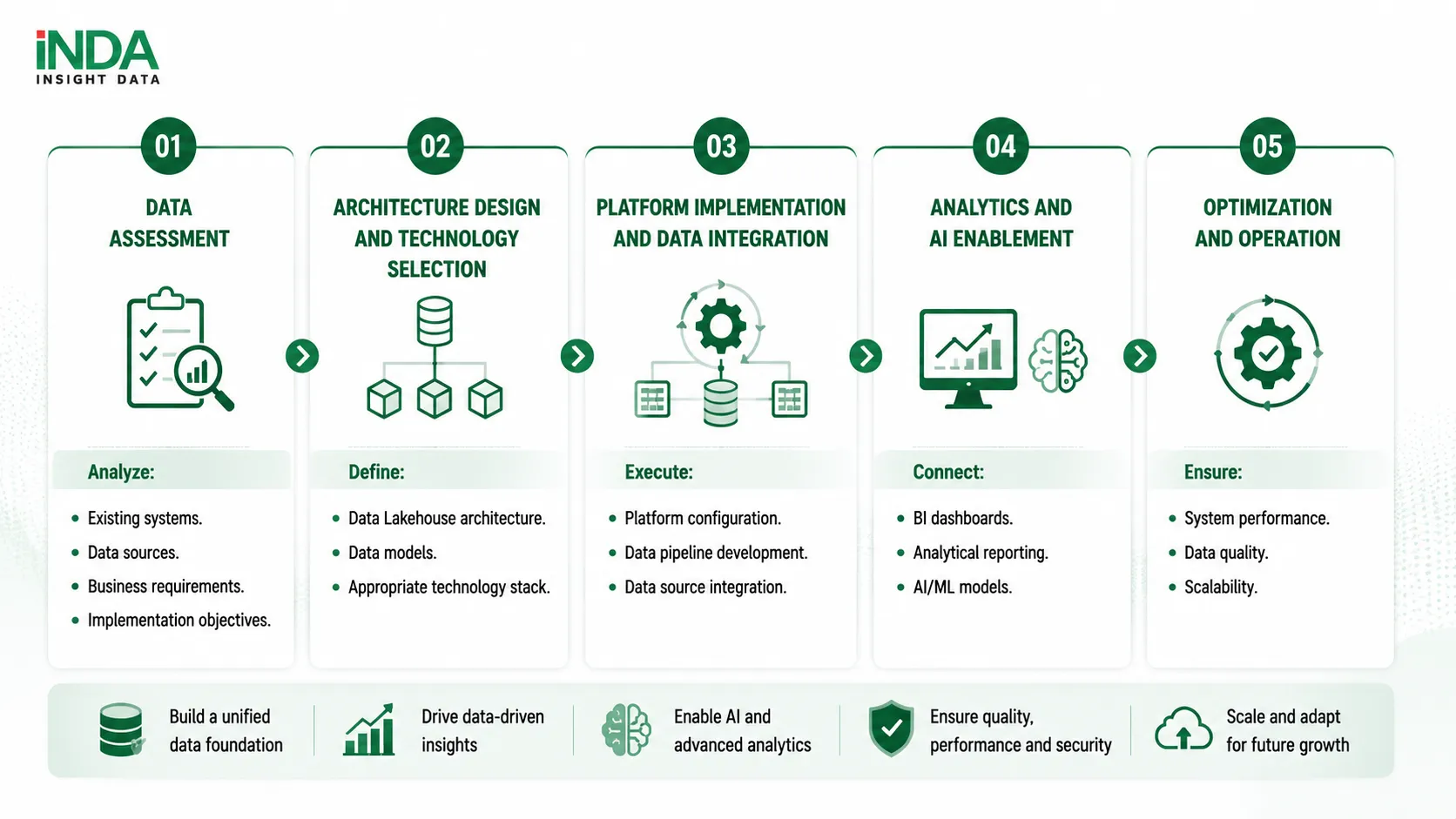
Data Lakehouse Implementation Process
Why Choose INDA?
1. Platform-Agnostic Data Lakehouse Consulting
INDA does not limit organizations to a specific technology vendor. Based on business requirements, existing infrastructure, budget, and future strategy, INDA recommends the most suitable Data Lakehouse architecture.
Organizations can leverage commercial platforms such as Oracle, Microsoft Fabric, Databricks, Cloud platforms, or open-source technologies.
2. Comprehensive Data & AI Ecosystem Expertise
Lakehouse implementation requires more than data storage. INDA helps organizations build an integrated data ecosystem including:
- Data Platform.
- Data Governance.
- Analytics & BI.
- AI Applications.
This enables enterprises to create a scalable foundation for future data and AI initiatives.
3. End-to-End Implementation Support
INDA supports the complete Data Lakehouse lifecycle:
- Data assessment.
- Architecture design.
- Platform implementation.
- Data integration.
- Performance optimization.
Helping organizations reduce implementation risks and accelerate business value from data.
Frequently Asked Questions (FAQ)
1. Why do organizations have large amounts of data but still struggle to generate business value?
Many organizations collect data from multiple systems such as ERP, CRM, operational applications, and databases. However, fragmented data environments make it difficult to access reliable information for reporting, analytics, and decision-making.
Data Lakehouse helps organizations establish a unified data foundation where information can be managed, analyzed, and leveraged more effectively.
2. Is Data Lakehouse necessary if an organization already has a Data Warehouse?
Many organizations find that traditional Data Warehouse environments become challenging when data volume, data types, and analytics requirements continue to grow.
Data Lakehouse extends data capabilities by supporting structured, semi-structured, and unstructured data while maintaining strong governance and analytical capabilities.
3. Does implementing Data Lakehouse require replacing existing data systems?
Organizations do not always need to replace existing systems. A well-designed Data Lakehouse architecture can integrate with current databases, applications, and data platforms.
INDA helps evaluate existing environments and develop an implementation roadmap that minimizes operational disruption.
4. How can organizations choose the right Data Lakehouse platform?
Selecting the right platform depends on multiple factors, including existing technology ecosystems, business requirements, security needs, scalability expectations, and investment strategy.
INDA provides technology consulting to recommend the architecture and platform that best fits each organization’s objectives.
5. Can Data Lakehouse help organizations prepare for AI adoption?
AI initiatives require reliable, accessible, and well-managed data. Without a strong data foundation, organizations may face challenges in developing accurate AI models and applications.
Data Lakehouse provides a scalable platform that enables organizations to prepare data for Machine Learning, Generative AI, and advanced analytics.
Contact INDA today to discuss the right Data Lakehouse strategy for your business.


